Can AI Solve Problems That Have Defeated Mathematicians for Decades?
AI is beginning to solve mathematical problems that have challenged leading researchers for years. In October 2026, OpenAI released 722 AI-generated mathematical manuscripts covering 372 families of results. Some proofs have been formally checked by computers; others still require independent scrutiny. The announcement unsettled mathematicians and raised a question that extends well beyond mathematics: if machines can perform the intellectual work on which people have built their careers, what happens to the value of human expertise?
Can AI Solve Problems That Have Defeated Mathematicians for Decades?
AI has come for the mathematicians.
We’ve heard plenty about artificial intelligence threatening the livelihoods of writers, artists, musicians and designers.
Now it’s the mathematicians’ turn.
The people whose careers are built on logic, reasoning and solving problems most of us wouldn’t even begin to understand.
And things have suddenly become very interesting.
Three bloody hours.
On 6 October 2026, OpenAI released 722 AI-generated mathematical manuscripts covering 372 families of mathematical results.
Some tackled problems that have occupied the world’s best mathematical minds for decades.
Many of the proposed proofs have been checked using mathematical verification software. Others are still being examined, and some may prove wrong.
According to OpenAI, each result required the equivalent of about three hours of ChatGPT Pro thinking time, on average.
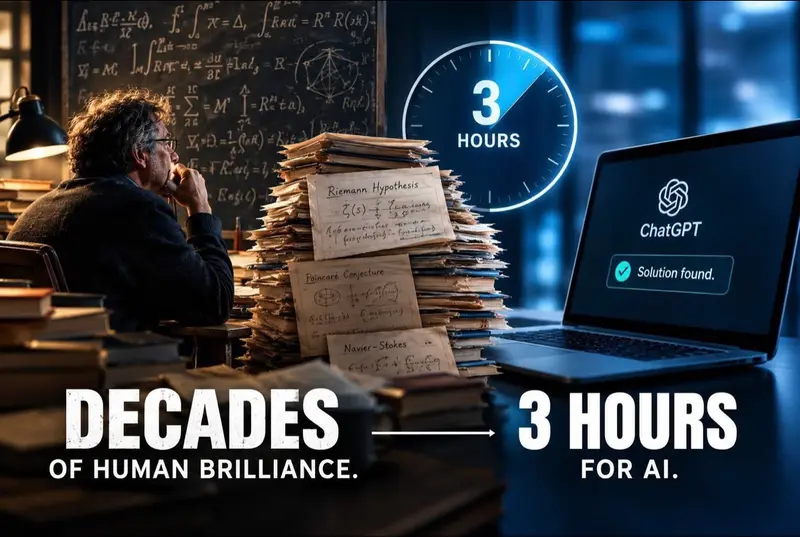
Three bloody hours.
Imagine spending years wrestling with a mathematical problem, then watching an AI system produce a proposed solution in an afternoon.
And we’re talking about some of the most difficult intellectual problems humanity has ever attempted.
Mathematicians are crying.
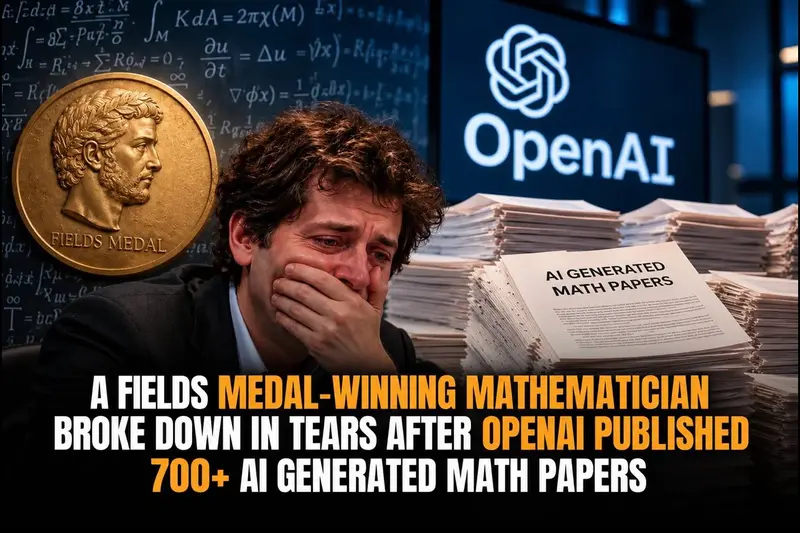
Hugo Duminil-Copin is one of the world’s leading mathematicians. He won the Fields Medal in 2022, one of mathematics’ highest honours.
Sixteen questions connected to his research appeared among the problems OpenAI’s system claimed to have tackled.
He was devastated.
He told fellow mathematicians that he’d cried during the night, waking his daughter.
He was grieving for his own work, his colleagues and the young mathematicians whose careers might now look very different.
Imagine devoting your working life to solving some of humanity’s greatest intellectual puzzles, only to discover that a machine might have beaten you to them.
That’s a hell of a thing to get your head around.
AI is challenging every kind of human intelligence.
The creative minds. Writers, artists, musicians, designers.
The analytical minds. Mathematicians, scientists, engineers.
The strategic minds. Researchers, lawyers, consultants, business leaders.
The people minds. Teachers, psychologists, counsellors, coaches.
People who have spent decades developing their knowledge, skills and expertise.
People whose professional identities are built around being exceptionally good at something.
Now AI is doing more of that work, often at extraordinary speed.
And getting better.
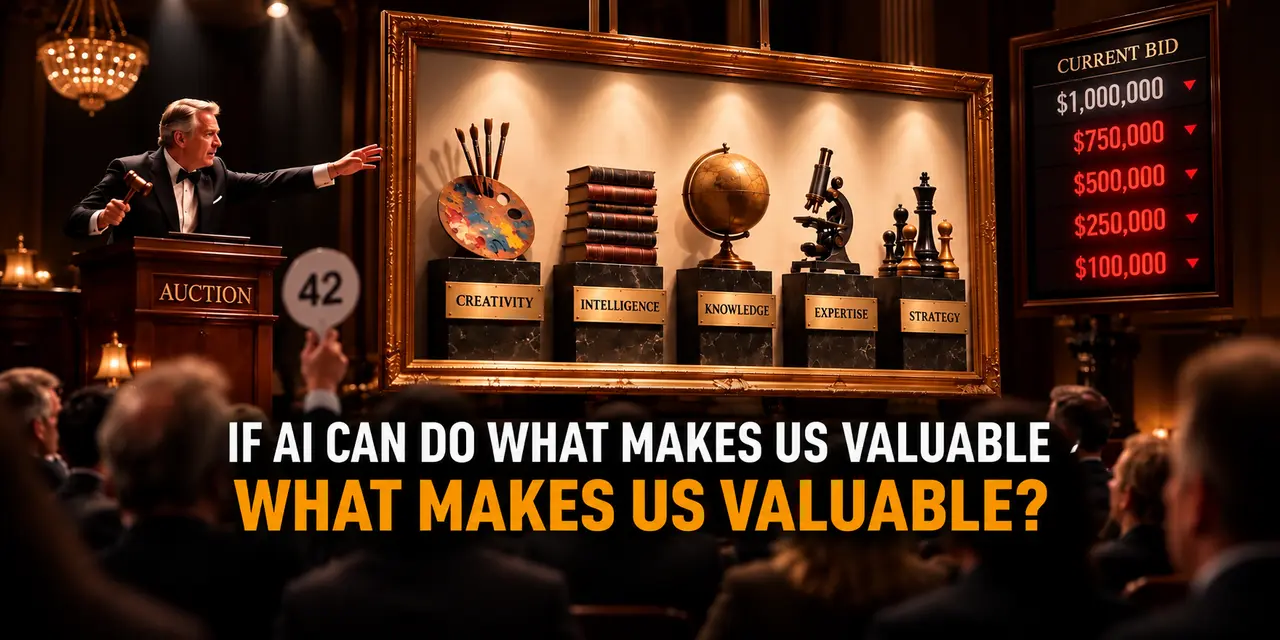
If AI can do what makes us valuable, what makes us valuable?
For generations, we’ve been encouraged to study hard, become experts, develop our talents and make something of ourselves.
Our ability to think, reason, imagine, create and solve problems has become how we earn a living.
For many of us, it’s also how we define ourselves.
I’m a writer. I’m a designer. I’m an engineer. I’m a mathematician.
What happens when the thing you’re brilliant at becomes something a machine can do?
Does your expertise become less valuable?
Does your experience matter less?
And if your work has always been a big part of who you are, what happens to your sense of identity when that work changes?
These are questions every profession is going to have to confront.
Mathematicians are confronting them now.
If AI can do what makes us valuable, what makes us valuable?